
Pitch decks follow a tighter script than most presentations because the reader is comparing you against dozens of alternatives. Sequoia's published guide to writing a business plan still describes the structure most investors expect. Investors read hundreds of decks a quarter; procurement teams sit through competing vendor pitches back to back. In both cases the reader is pattern-matching at speed, and a deck that makes them work to find the point loses to one that doesn't. The best pitch deck templates aren't the prettiest — they're the ones that match the structure the reader already expects.
The 10-slide spine for fundraising
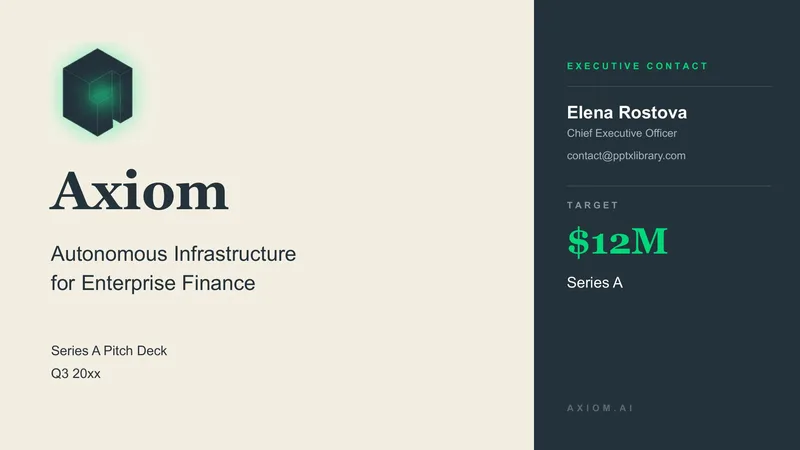
Most successful seed and Series A decks share the same backbone. Cover slide with company name and a one-line positioning. Problem slide that names a specific, expensive pain point. Solution slide that shows your wedge — not the full product vision. "Why now" — what changed in the world that makes this possible today. Market size with both a top-down and a bottom-up read. Product slide with a real screenshot, not a feature list. Traction with usage or revenue or a leading indicator. Business model and unit economics. Team. Ask: how much, what runway it buys, and which milestones it unlocks.
A good template gives you all ten layouts with the labels already in place, so you don't end up with five "Solution" slides and no "Why now."
Sales pitches are a different deck
Founders often reuse their investor deck for customer meetings, and it consistently underperforms. The two audiences want opposite things. An investor is buying a company's future and cares about market size, defensibility, and the team. A buyer is solving a problem this quarter and cares about whether you'll work with their existing stack, what it costs, and who else like them already uses it.
A B2B sales deck therefore inverts the structure: open on the client's challenge rather than your company, quantify the cost of leaving it unsolved, then show the return. Case studies and named logos do the work that traction slides do for investors. Pricing belongs in the deck, not deferred to a follow-up — vague pricing reads as a negotiation tactic and slows the deal. Close with a concrete next step rather than a thank-you slide.
What makes a slide earn its place
A slide earns its place when it does something a one-line bullet on the previous slide couldn't. Microsoft's reference on what a slide master is explains why keeping those layouts consistent matters once the deck grows. If you can collapse a slide into a sentence on the slide before it without losing meaning, collapse it. Denser decks win with readers who are scanning. Templates that hand you twenty "About us" variants are working against you — pick the ones with a clear narrative structure and delete the rest before you start writing.
Where pitch decks usually die
The solution slide is where most fundraising decks lose the room. Founders treat it as a product tour and list ten capabilities. Investors read that as "this team hasn't picked a wedge."
The traction slide is the second-most common failure: vanity metrics dressed up to look like growth. Cumulative totals that can only go up, registered users where active users would be lower, month-over-month percentages off a tiny base. Sophisticated readers decode these instantly, and the credibility cost is worse than the weak number would have been. A template can't fix bad metrics, but a good traction layout forces honesty — one line per period, one number per row, no room to hide.
For sales decks, the equivalent failure is the feature matrix: three columns of checkmarks that answer a question the buyer hasn't asked yet. Establish the problem and the value first; the comparison grid belongs near the end, once the buyer already wants the outcome.